Concrete, Cracks and a Stairwell Mural: A Kinder Look at Trelispen’s Ring Road Block
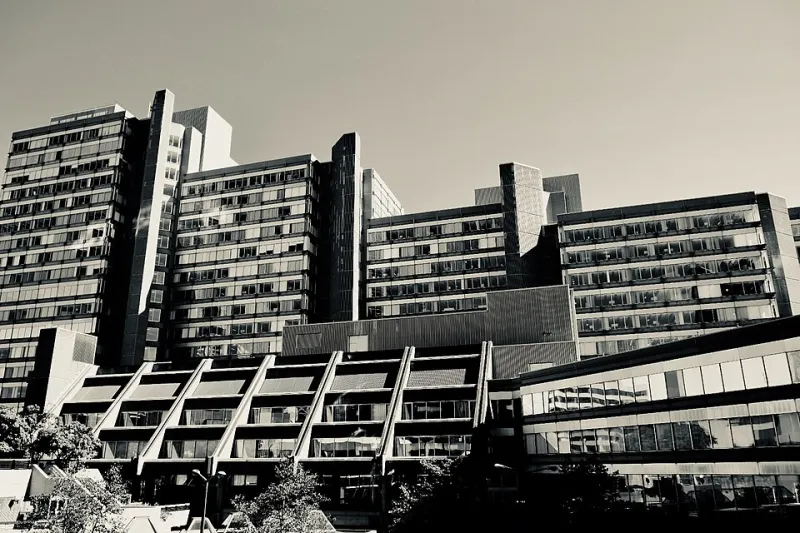
Photo: joanne clifford, CC BY 2.0, via Wikimedia Commons
Let us begin with an admission: the building is not beautiful. It sits on the ring road like a filing cabinet that has been left out in the rain, all grey panels and hard edges and a ground floor that seems to be apologising for the upper floors. People in Trelispen do not say ‘meet you at Crown Barton House’ with any affection. They say ‘you know, the ugly block by the roundabout.’ And yet.
Crown Barton House is the 1970s office block that everyone loves to dismiss. It is the sort of building that gets described as ‘dated’ in council reports and ‘a blot’ in the pub. It has been threatened with redevelopment, wrapped in scaffolding, and used as a shorthand for everything that went wrong with town planning after the war. It is also, stubbornly, useful.
The case for the ugly block
Here is what Crown Barton House does that a prettier building might not. It houses things. Not glamorous things, mostly: a housing advice drop-in, a dentist, a couple of small businesses, a training room that smells faintly of coffee and carpet tiles. The lift is slow. The stairs are wide. The noticeboard in the lobby is a mess of laminated signs and handwritten cards. It is the kind of place where you can turn up without an appointment and someone will eventually see you.
That is not nothing. In a town that has lost more than a few useful buildings to conversion and redevelopment, Crown Barton House has kept doing the unglamorous work of civic life. It is not a destination. It is infrastructure.
Then there are the murals. If you have only ever driven past, you will have missed them. The stairwell, which smells of floor polish and old rain, has a set of painted panels running up the first three flights. They are abstract, geometric, faintly psychedelic — all orange circles and green diagonals — and they were painted, according to the plaque by the fire door, by a local art group in 1974. They are not good in any conventional sense. They are also completely wonderful: a bit of colour in a building that has spent fifty years being told it is grey.
‘I’d knock it down tomorrow’
Not everyone is convinced. Outside the café on the corner, I spoke to Danny, who has run a sandwich van on the ring road for eleven years. ‘It’s grim,’ he said, cheerfully. ‘No two ways about it. You look at it and you think, who signed that off? But the dentist is in there, and the advice place, and I’d rather have it than another block of flats nobody can afford.’ He paused. ‘I’d still knock it down tomorrow if you gave me a bulldozer.’
That seems to be the general mood. People do not love Crown Barton House. They tolerate it. They use it. They have a favourite grievance about it — the lift, the heating, the way the wind funnels round the entrance in February. But when the last serious proposal to redevelop the site came round, the same people who called it ugly turned up to the consultation to ask where the dentist would go. Affection, in a town like Trelispen, often looks like a list of practical objections.
Looking at civic architecture with kinder eyes
There is a tendency, when we talk about buildings, to divide them into the lovely and the worthless. A Georgian terrace: lovely. A 1970s office block: worthless. But most of the buildings we actually use are neither. They are adequate. They are useful. They are the backdrop to a hundred small interactions a week. Crown Barton House is not a masterpiece. It is a decent, stubborn, slightly shabby piece of civic furniture.
That does not mean we have to pretend it is beautiful. It is not. The panels are stained. The entrance is unwelcoming. The lighting in the stairwell could generously be called ‘moody’. A kinder eye is not the same as a blind eye. We can acknowledge the flaws and still ask a better question than ‘is it pretty?’ We can ask: does it work? Who uses it? What would we lose if it went?
The murals in the stairwell are a good place to start. They are not famous. They are not by anyone you have heard of. They are evidence that someone, in 1974, thought this building was worth decorating. That someone imagined people would climb those stairs every day and might like a bit of orange to look at. That is not a small thing. It is the kind of small thing that makes a town feel like a place rather than a collection of buildings.
So no, Crown Barton House will never win a beauty contest. It will never be on a postcard. But it is part of Trelispen, and it is doing a job. The least we can do is look at it properly — cracks, murals, stubborn usefulness and all.