Wardrobe Door Rhapsody: One Saturday Morning With Trelispen's Tip-Top Sessions
By half nine the fog has lifted off the yard and the first cars are already queuing at the weighbridge. Nothing unusual about that. What is unusual is the noise coming from the far corner, past the skips, where somebody appears to be tuning a bicycle wheel with a spanner and quietly losing the argument.
Welcome to the Tip-Top Sessions, Trelispen's least likely monthly gig. Once a month, the household waste and recycling centre on Gwelorrow Road opens a corner of its yard to anyone who fancies making music out of things that have been thrown away. It has been running for a little over two years, it costs nothing, and it has quietly become one of the nicest Saturday mornings in town.
How a skip became a band
The idea belongs, more or less, to Marek Ostrowski, a retired joiner who spent thirty years fitting kitchens and now spends his retirement rescuing the parts of them that other people don't want.
"I kept seeing the same things," he says, leaning on a broom handle that has been pressed into service as a music stand. "Wardrobe doors. Bike frames with one good wheel. Tins. Perfectly decent bits of wood with a history, going into a skip because a hinge had gone."
A conversation with Priya Nandy, a primary school music teacher who volunteers at the site's reuse shop on Saturdays, turned the grumble into a plan. The site operator agreed to a trial morning. The trial morning turned into two. Two turned into a fixture.
"We had about nine people the first time and half of them were staff," Priya says. "Last month we had thirty-four. I think the record is a family of five who turned up at ten past ten and stayed until we packed up."
What it actually sounds like
Not, it has to be said, like a bin lorry in a tumble dryer. The Tip-Top Sessions are louder and stranger and occasionally quite beautiful.
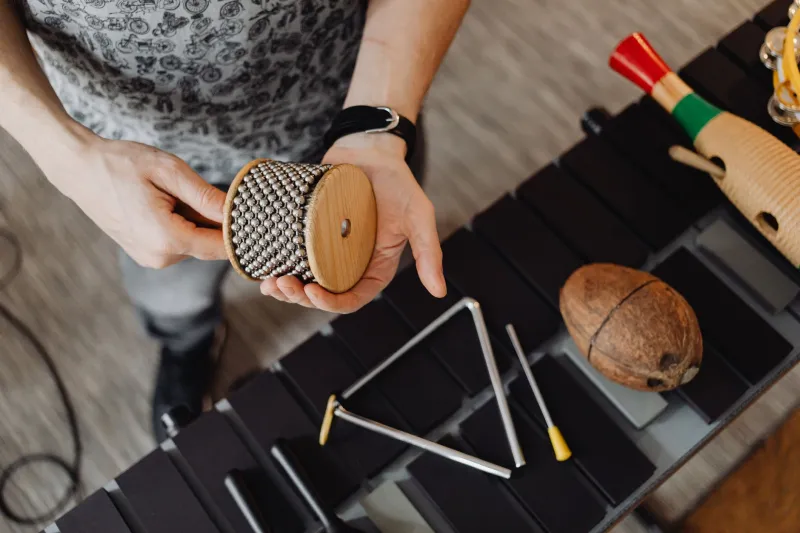
The core of the band is a set of instruments built and maintained by whoever turns up. There is a tin choir: a rack of washed-out food tins cut to different lengths with a drumstick hanging off it, which you hit with a padded stick and which produces something between a marimba and a church bell. There is the wheel rack, three bicycle wheels on a frame that you spin and strike, and which hum for far longer than seems reasonable. There is a corrugated sheet nicknamed the Thunder Run. And there is the door.
"The door is the star," says Bronwen Voss, who has been coming since April and describes herself as "not a musician, just someone with good timing". The door in question is a wardrobe door, sawn down and mounted on a wooden frame, played with soft mallets. It has a low, warm thud that you can feel in your chest.
Around this skeleton, the rest of the morning builds itself. Somebody brings a tambourine. Somebody else rigs up a string of old cutlery on a coat hanger. A child discovers that two plastic drainpipes struck together make a note, and then discovers it again, and then again, for some time.
The rules of the yard
The Sessions are not a free-for-all, and it's worth knowing how they work before you turn up clutching a broken hoover and a dream.
Everyone signs in at the portacabin. Everyone gets a hi-vis waistcoat and gloves. Closed-toe shoes are non-negotiable, which has caught out at least two people in sandals over the years. Nothing gets dismantled that hasn't been cleared by site staff first, and nothing sharp or heavy gets handed to a small child, no matter how much they insist.
"There's a health and safety conversation and it's a proper one," Priya says. "But it's also a room full of people making something together, which is the same thing really. You just say it twice."
Instruments stay on site. You can't take a bicycle-wheel zither home with you, tempting as that turns out to be. You can, however, suggest a new one, and several regulars now have their names attached to instruments in the way that people get buildings named after them.
First-timers and the second-half problem
Nathan arrives at twenty past ten with his daughter Elsie, seven, who has been told there would be drums and has arrived ready to be disappointed.
There are, it turns out, drums. She is not disappointed. Within twelve minutes she has been assigned to the tin choir, told she has excellent timing by a woman she has never met, and completely forgotten her father is there.
Nathan, meanwhile, is handed a mallet and pointed at the door. "I have genuinely no idea what I'm doing," he says, laughing. "But I'm doing it in time with everybody else, so it sort of works."
The informal rule is that the second half is where it all comes together. The first hour is tuning, arguing and inventing. From eleven onwards, Priya calls a loose kind of order and the whole yard settles into something with a pulse. It is not a performance. There are no tickets and no audience. But people stop what they're doing. Staff lean on the railings. A man delivering a mattress pauses halfway through a lift to listen.
Why it works
Ask anyone there and you get roughly the same answer, arrived at differently.
"It's the least wasteful thing I do all month," says Bronwen. "Not just the stuff. The morning."
Marek puts it in terms of joinery. "A wardrobe door that's been in a house for forty years has a sound in it. You don't make that. You just find the right way to knock on it."
And Priya, who spends her weekdays teaching seven-year-olds to hold a recorder, says the Sessions work because nobody is being judged. "There is no wrong note on a tin of chopped tomatoes. That's why people relax. Everyone's rubbish at it, including me, and it still sounds like something."
Pop along
The Tip-Top Sessions run on the third Saturday of the month, 10am–noon, at the household waste and recycling centre on Gwelorrow Road. The next one is Saturday 21 November 2026. Entry is free, no booking needed, but places are capped at forty and regulars suggest arriving before half ten. Gloves, closed-toe shoes and hi-vis are provided — bring a warm coat and, if you have one, a sense of rhythm you're willing to lend out. Children welcome with an adult. Instruments stay at the tip.