Bury a Bus Timetable? Trelispen’s 2026 Time Capsule Wants Your Odd Little Treasures
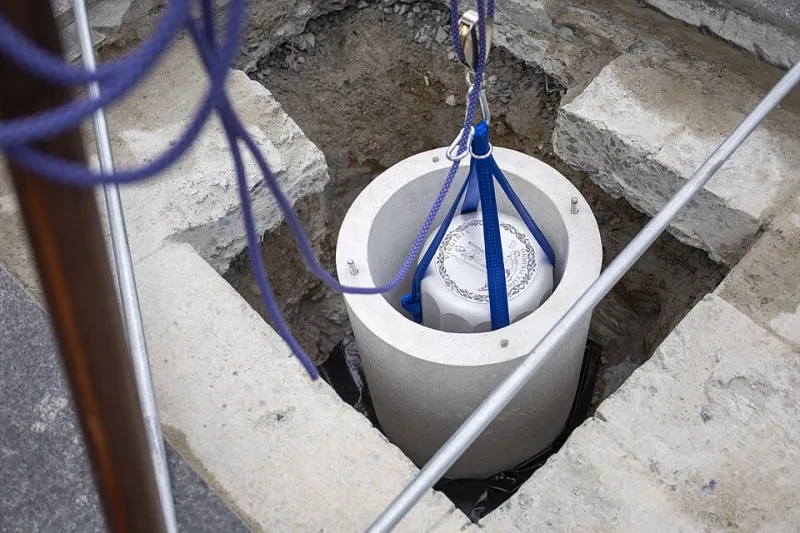
Photo: U.S. Department of the Interior, Public domain, via Wikimedia Commons
There’s a certain kind of Trelispen conversation that starts in the queue at the bakery and ends with somebody saying, ‘We should bury it.’ Usually it’s about a wonky chair, or a slice of the old station sign that fell off in a gale. This autumn, it’s about the whole town.
A loose group of library staff, heritage volunteers and at least two people with strong opinions about the Christmas lights has floated the idea of a Trelispen 2026 time capsule. Not a grand, sealed-and-forgotten affair. More a town-sized message in a bottle, packed by the people who actually live here.
Why bother with 2026?
Because 2026 is not obvious. That’s the point. The years that get remembered tend to be the ones with a royal wedding, a flood or a new bypass. Ordinary years slip through the net. And ordinary is exactly what gets lost.
Think about what you’d want to know about Trelispen in, say, 1976. Not the official minutes of the town council. The price of a pasty. What the bus timetable looked like. Which shop was on the corner before it became a charity shop before it became a coffee place. What teenagers did on a Saturday. What the weather did to the allotments.
A time capsule is just a very slow letter to people who haven’t been born yet. It doesn’t need to be precious. It needs to be specific.
The case for the boring object
The best capsule items are usually the ones that feel too ordinary to keep. A bus timetable. A takeaway menu. A school newsletter. A photo of the queue outside the chippy on a Friday. A copy of the free paper with the planning notices still in it.
Playful suggestions have already started doing the rounds. Someone wants to include a single glove from the lost-property box at the station. Someone else has proposed a recording of the café's Friday-night knitting circle, which is either lovely or a sign that the town has run out of ideas. It’s lovely. There is a campaign for a sealed jar of air from the harbour on a particularly windy Tuesday. There is a counter-campaign for a jar of actual harbour mud, which has been ruled out on the grounds that nobody wants to open that in 2051.
The serious point underneath the jokes is this: a time capsule should smell of the town. Not literally, ideally. But it should feel like it was made by people who knew what day the bins go out.
The practical bit: how to build one that survives
This is where good intentions usually meet damp. A time capsule is only as good as its box, its location and its inventory. Get those three wrong and you’ve buried a soggy shoebox with a nice label.
The current working plan is modest. A sturdy, airtight container — something along the lines of a plastic storage crate with a rubber seal, not a biscuit tin. Contents packed in acid-free paper or polyester sleeves. Silica gel sachets to deal with moisture. Everything labelled with a date and a name, even if the name is just ‘unknown child, harbour drawing, 2026’. A printed inventory taped to the inside of the lid and a copy kept at the library.
Digital items are welcome, but not as the only copy. A USB stick is a nice idea until the port changes. A cloud link is a nice idea until the account expires. If you want to include photos or a recording, put a printed description in the box and lodge the file with the heritage group as well. Future historians should not have to guess a password.
Where would it live?
Not literally underground, if anyone can help it. Trelispen has a high water table and a long history of people digging holes in the wrong place. The favoured option is a cupboard in the library strongroom, with a second, smaller capsule in the Old Station Café for anyone who wants to add a late contribution. The town council has been asked, politely, whether it would mind being the official guardian. The heritage group has offered to keep the inventory. The café has offered tea, which is not strictly relevant but is very much in the spirit.
The proposed opening date is 2051. Twenty-five years feels about right: long enough to be interesting, short enough that someone who packed it might still be around to watch.
So who decides what makes the cut?
This is the awkward bit. Every time capsule is a tiny act of editing. Someone chooses what represents a town, and someone else gets left out. The organisers are keen to avoid a capsule that’s just the hobbies of the people on the committee.
The plan is an open call for suggestions, followed by a shortlisting panel and a public vote. The panel would include two heritage volunteers, two library staff, one town councillor and one person under 18 who is not related to anyone on the panel. The public vote would happen at a Saturday market in December, with a suggested donation for votes going towards the library’s local history collection. It is not perfect. It is at least an attempt to spread the decision around.
There will be limits. Nothing perishable. Nothing valuable. Nothing that needs a plug. Nothing that would be embarrassing to open in front of the mayor. And nothing that only makes sense if you were there — which rules out about half the suggestions so far.
How to pitch your object
Keep it short. One sentence on what the object is, one on why it says something about Trelispen in 2026, and a photo if you have one. Drop it into the library or email the heritage group. The current deadline for suggestions is 12 December 2026, with the box due to be sealed in the new year.
You don’t have to be a historian. You don’t have to be a hoarder. You just have to notice the thing that would be missing if someone cleared out your kitchen drawer tomorrow.
A time capsule is not really about the future. It’s about admitting that the present is worth a second look. And in a town like Trelispen, the second look is usually where the good stuff is.