The Knot Code: Following the Woolly Trail Across Trelispen
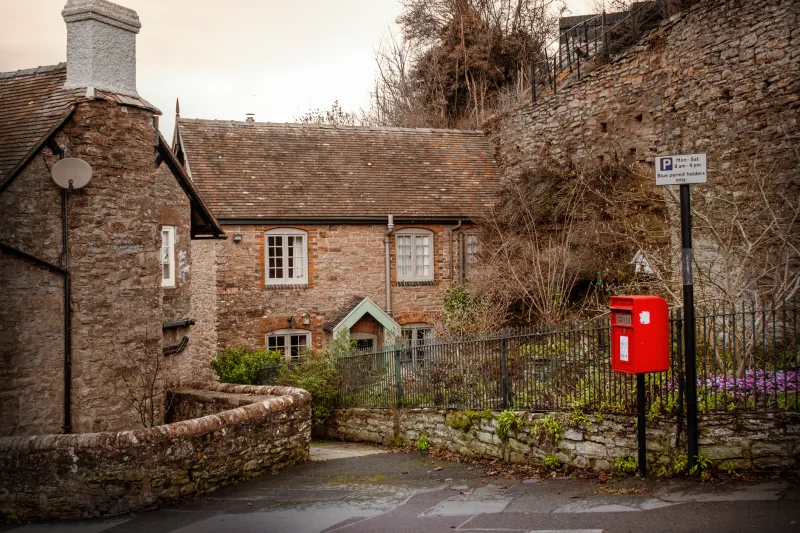
On a damp Tuesday morning, the pillar box on Market Cross is wearing a fox. It is a very good fox: orange wool, white chin, a tail that curls around the black paintwork like it has somewhere to be. Beneath it, stitched in careful yellow letters, are three characters and a number. Nobody seems entirely sure what they mean, but a small crowd has opinions.
"It's a grid reference," says a man with a shopping bag and the confidence of someone who has already solved it. "Or a bus route. Or a postcode for somewhere that hasn't existed since 1974." His friend disagrees. "It's a poem," she says. "They're all poems. You just have to stand in the right place."
This is what passes for a mystery in Trelispen: wool, a few letters, and a town happily arguing with itself on a wet pavement. Since late September, at least fourteen postbox toppers have appeared across the town, each one handmade, each one different, and each one carrying what looks suspiciously like a clue. There has been no announcement, no plaque, no helpful note from the council. Just a trail of knitted creatures and objects, quietly asking to be followed.
A Topper Appears
The first one turned up on a pillar box near the old station. It was a teacup, complete with a tiny saucer and a stitch that looked like steam. According to the town's community page, it lasted four days before anyone mentioned it online. By then, a second topper had appeared on Bramble Lane: a bee, slightly lopsided, with the letters H2 worked into one wing.
After that, people started paying attention. A rook appeared near the war memorial. A tiny knitted bus shelter showed up outside the actual bus shelter on Fennel Row. A mushroom, a pair of spectacles and what might be a very small haddock followed. Each one was fixed to its postbox with what looks like florist's wire and an almost aggressive neatness. Each one had a clue.
"They're not random," says Priya, a postal worker who has become an unofficial archivist of the trail. "I do the same round most days, and I've watched them arrive. The person behind them is organised. They must be out very early, or very late, and they know when the boxes are empty enough to work on."
Priya has been photographing each topper and pinning the pictures to a corkboard in the sorting office. It is not an official display. It is more of a quiet obsession. "You start noticing things," she says. "The fox has a number. The bee has letters. The rook has both. There's a pattern, but every time I think I've got it, someone finds a new one somewhere else."
The Clues in the Wool
The toppers are not simply decorative. Most carry a motif, a set of characters, and occasionally a small symbol: a wave, a leaf, a tiny key. The fox on Market Cross, for example, has W3 stitched beneath its paws. The teacup near the station has B7. The bee on Bramble Lane has H2. The rook has S4 and a small stitched arrow pointing east.
Residents have tried all the obvious things. W3 could be a grid square, a bus route, a page in a local history book, or the third word of a particular sentence. B7 might be a postcode fragment, a hymn number, or the seventh bench in a park. H2 could be a bus stop, a footpath, or a very local joke about hydrogen. Nobody has yet produced a map with a triumphant cross on it.
"I think it's a walk," says Margaret, a retired teacher who has been following the trail with her grandson. "The clues aren't meant to be solved sitting down. You have to go to the place and look around. The topper tells you what to look for, and the letters tell you where to stand."
Her grandson, Alfie, is less convinced. He is eight and has his own theory. "It's a secret code for a treasure," he says. "But the treasure is probably cake." He pauses. "Or a really good stick."
Following the Trail
On Saturday, I tried to follow the wool. I started at Market Cross with the fox, then walked to the station, then to Bramble Lane, then to the war memorial. It took an hour and a half, mostly because I kept stopping to check whether a drainpipe or a hanging basket might be a clue. It was not a tidy route. It doubled back. It went past the chippy twice. At one point, I was fairly sure I was being watched by a knitted haddock.
But something did happen. By the time I reached the fourth topper, I had started noticing the town differently. The arrow on the rook pointed towards a row of Victorian houses. The wave on the teacup was the same shape as the railings outside the library. The bee's H2 sat directly opposite a bus stop that has been out of use since the 1990s. None of it proved anything, but all of it felt deliberate.
That, I think, is the point. The toppers are not just cute. They are a set of instructions, or perhaps a set of invitations. They ask you to look at a pillar box, then at the street around it, then at the people who use it. They turn a five-minute walk into a twenty-minute one. They make you late for things.
The Town Plays Along
What has surprised residents most is how quickly the trail has become communal. A local florist has started selling small balls of wool in the toppers' colours. The library has a display of books about knitting, maps and local history. Someone has set up a shared spreadsheet to log each topper's location, date and clue. It is not official. It is not accurate. It is very Trelispen.
"We don't know who's doing it," says Tom, who runs the hardware shop on the high street. "But they're clearly local. They know which boxes get used. They know where the pavement is wide enough. They've got a sense of humour, too. The haddock was a bold choice."
There are theories, naturally. A retired art teacher. A group of friends. A WI splinter cell. Someone's nan, operating with military precision and a very good stash of acrylic yarn. The maker has not come forward, and the toppers keep appearing. As of this week, a small knitted clock has turned up near the bus station, its hands fixed at ten past four. Nobody knows what it means. Everyone has a guess.
Not Quite a Reveal
It would be easy to end this with an unmasking, a name, a neat explanation. But the toppers do not seem interested in that. They are a small act of yarn-bombing, yes, but they are also a puzzle that has persuaded a town to walk around it with its eyes open. That is rarer than it sounds.
So the trail continues. The fox still wears its W3. The bee still points its H2 at a dead bus stop. The haddock remains unexplained. If you have a spare afternoon, follow the wool. Take a notebook. Take a friend. Take a child who thinks the treasure is cake. And if you do crack the code, do let the rest of us know. We will be at the pillar box on Market Cross, arguing about grid references.
In the meantime, buy a stamp. It seems only polite.